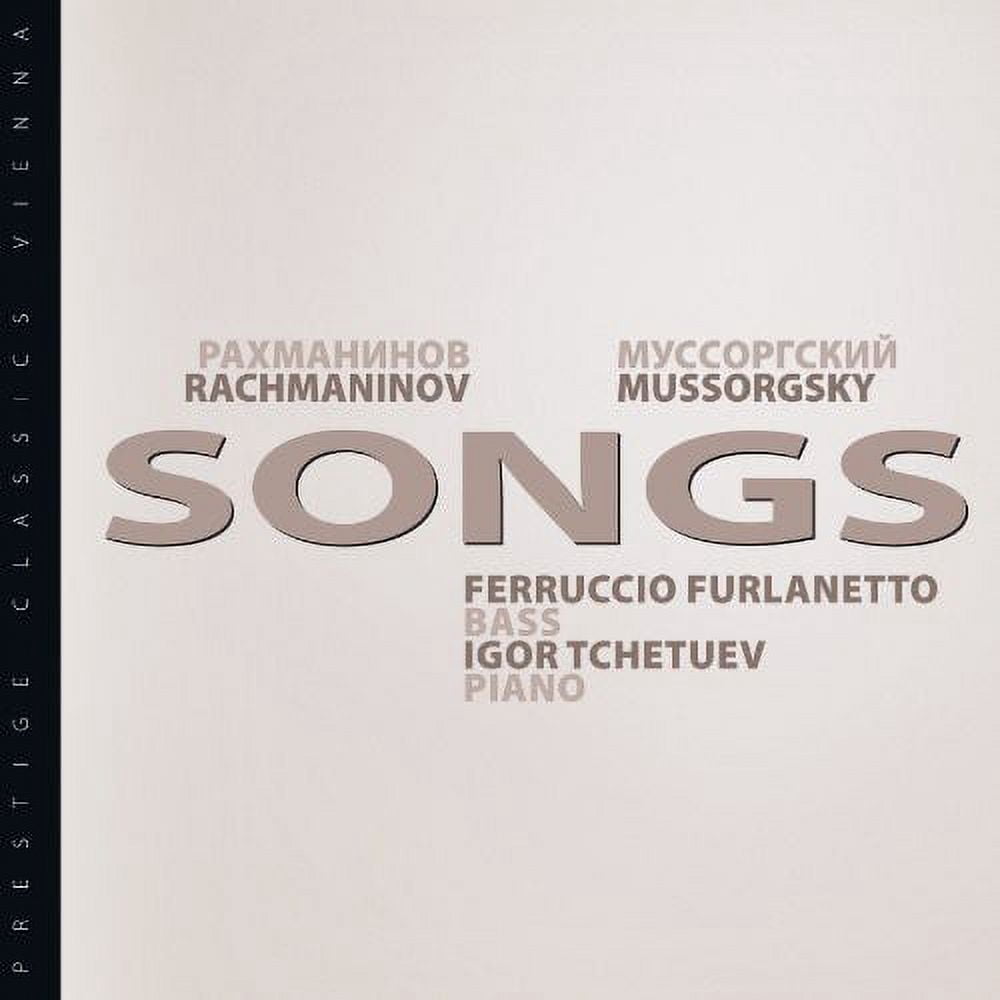
Songs
Product details
| Management number | 255353807 | Release Date | 2026/11/21 | List Price | US$24.61 | Model Number | 255353807 | ||
|---|---|---|---|---|---|---|---|---|---|
| Category | |||||||||
The presented recording combines two of sustainably impressing species of the development of the (art) song of the 19th century: the lyrical romance appealing with it's melodic cantability and the dramatic-expressive, mostly strikingly rhythmic ballade, which gains full effect by it's underlying words. It is quite interesting how Mussorgsky is characteristically enlarging the romance-type song in his early creative period before quot;Boris Godunovquot; within only six years. 1858, with less than twenty years he set A. Pleshchev's quot;The leaves were sadly rustlingquot; to music (see [9] as the earliest of the presented songs) completely in the style of the traditional song-like romance, as it has been established by M. Glinka and A. Dargomizhsky as a kind of synthesis between western-romantic, especially Italian art song and the early Russian folksong tradition in the musical drawing-rooms of St. Petersburg and Moscow. Six years later Mussorgsky is developing this traditional musical spectrum of forms and expressions in a real revolutionary way with his composition of Pushkin's quot;Nightquot; (see [12] as the latest piece in the group of songs quot;before Borisquot;), by adapting the song line to the typical Russian language melody and by dissolving thus for example the musical formal forces of a permanent beat-bound measure. The innovative power of Mussorgsky was opening new possibilities and is shown very distinctly in this example, when considering the independent role of the piano, it's harmonics reaching to the limits of diatonic and the shade of the expression achieved by this. It is no wonder, that composers from Debussy to Janácek and (of course!) Shostakovich have intensively studied Mussorgsky's endeavours to seize idiomatical language melody with means of music and have adapted them to their respective language-cultural context. The dramatically creative moments of ballades is typical for the cycle of quot;Songs and dances of deathquot;, which can be pursued back to Mussorgsky himself in his versions resp. Revisions of quot;Borisquot;. In all four tales death himself is the real protagonist and is shown as the salvator from misery and suffering of the world (see [14], [15] und [16]), and the final and real winner of any war (see [17]). When death is dissolving the misery of the poor peasant by dancing (see [16]), when he is erasing the personality of the mortally ill young woman in his serenade (see [15]), when he is singing the moaning child into eternal peace (see [14]), or when he is enjoying his final triumph as the real field-marshal in apocalyptical ecstasis (see [17]), then Mussorgsky is using musical elements, which are emphasizing the dramatically expressive moments of the episodes in a prototypical way and thus continuing the history of the ballade as a song species in a very effective mode. Musical expression in order to increase the meaning of the words is shown in the quot;Lullabyquot;, where the dialogue between the increasingly agitated mother and the permanently soothing death is created by different paces. In quot;Trepakquot; or quot;Serenadequot; the gradual weakening of the (dancing) rhythm shows, that death is incessantly reaching his goal. In quot;The field-marshalquot; death is accompanied at the beginning by scarce accords, than the piano is intensified more and more and thus becoming the background for a triumph march of the victory speech. Mussorgsky was planning at least three more quot;Death dance songsquot; - trying new composition ideas mostly in close cooperation with his mentor,
Songs| Performer | Ferruccio Furlanetto |
|---|---|
| Music genre | Classical |
| Music subgenre | CD - CLASSICAL ARTISTS |
| Music release type | Release |
| Media format | CD |
| Original release date | 2010 |
| Edition | Standard |
| Has parental advisory label | N |
| Number of discs | 1 |
| Series title | Ferruccio Furlanetto - Songs [COMPACT DISCS] |
| Track listing | Fate / Schicksal,A Dream / Ein Traum,The Lilacs / Spanischer Flieder,In the Silent Night / Im Schweigen Der Nacht,I Came to Her / Ich War Bei Ihr,It's Time / Es Ist Zeit,Oh Stay My Love Forsake Me Not! / Bleib Doch Verlass Mich Nicht!,Spring Waters / Frühlingsgewässer,The Leaves Were Sadly Rustling / Es Rauschten Die Blätter So Traurig,Whart Are Words of Love to You? / Was Gilt Euch Ein Liebesschwur?,Old Man's Song / Das Lied Des Alten Mannes,Night / Die Nacht,The Wild Winds Blow / Es Pfeiffen Die Winde,Songs and Dances of Death - Lullaby / Lieder Und Tänze Des Todes - Wiegenlied,Songs and Dances of Death - Serenade / Lieder Und Tänze Des Todes - Serenade,Songs and Dances of Death - Trepak / Lieder Und Tänze Des Todes - Trepak,Songs and Dances of Death - the Field-Marshal / Lieder Und Tänze Des Todes - Der Feldherr |
| Record label | CD Baby |
| Composer | Mussorgsky, Sergei Rachmaninov |
| Music media format | CD |
| Is edited | N |
| Is enhanced | N |
Bestseller ranking
Classical Composers
Correction of product information
If you notice any omissions or errors in the product information on this page, please use the correction request form below.
Correction Request Form